
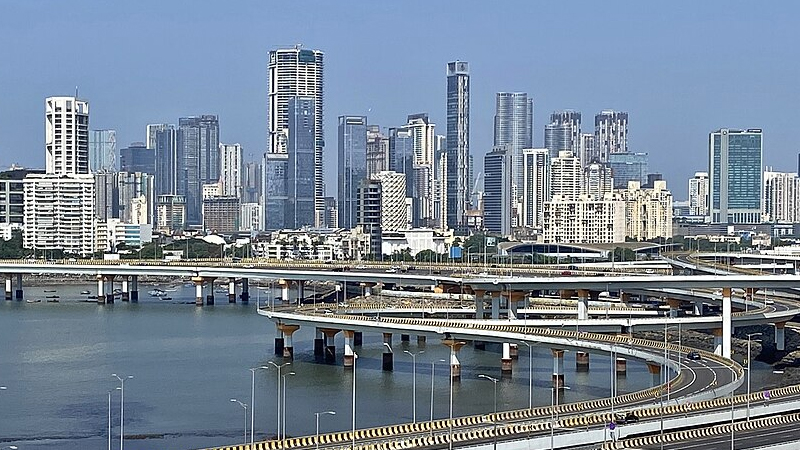





Indian real estate is undergoing perhaps its most important structural transformation in decades. What was once viewed as a fragmented, opaque, and cyclical sector is steadily evolving into a regulated, institutionalized, and infrastructure-driven asset class with rising global credibility. This change is particularly important for Indians living abroad which increasingly sees Indian property not merely as an emotional purchase, but as a strategic long-term wealth preservation asset.
The timing of this transformation is important. Amid geopolitical instability, inflationary pressures in advanced economies, volatile equity markets, and slowing global growth, India continues to remain one of the world’s fastest-growing major economies.
According to the IMF and RBI, India’s GDP growth is projected at around 6.5-7% for FY26 and FY27, well ahead of most developed economies. Meanwhile, the Indian real estate sector currently contributes about 7-7.3% to GDP (as of 2024-2026 data from KPMG and others), with long-term forecasts reaching 13-15% by 2030 or 15.5% by 2047 per IBEF and industry reports.
This is no longer a market driven purely by speculation or short-term price cycles. The current real estate cycle is being powered by end-user demand, institutional capital, infrastructure expansion, regulatory discipline, and the growing financial sophistication of domestic and overseas Indian investors.
A link to India’s economic story
India’s real estate expansion aligns with the country’s economic goals, including the Viksit Bharat vision. Recent estimates from KPMG and Mordor Intelligence value the market at USD 300-585 billion around 2024-2026, projected to reach USD 926 billion by 2031 or INR 88 trillion (~USD 1 trillion) by 2030. By 2047, FICCI-KPMG and NAREDCO-Knight Frank reports forecast the sector at USD 5.8 trillion, up from USD 477-650 billion in recent years.
This growth is not happening in isolation. Real estate today is deeply integrated with India’s urbanization, manufacturing expansion, digital economy, and infrastructure modernization.
The sector currently supports nearly 70 million jobs, making it the country’s second-largest employer after agriculture. Every major infrastructure investment now has a direct multiplier effect on housing, office space, retail, warehousing and logistics.
Capital inflows further reinforce this transformation. According to CBRE-CII and JLL data, Indian real estate attracted nearly USD 30.7 billion in equity inflows between 2024 and Q1 2026, reflecting an 88% increase over the previous cycle. Importantly, this capital is increasingly equity-led rather than debt-led, indicating stronger institutional confidence in India’s long-term property fundamentals.
The rise of the ‘trust premium’
The most significant transformation in Indian real estate is the emergence of trust as a market differentiator. The implementation of RERA fundamentally changed the sector’s operating structure by introducing escrow mechanisms, mandatory project registration, standardized disclosures, and accountability in delivery timelines.
Before RERA, under-construction projects carried significant execution risks, particularly for NRIs with limited visibility into project progress. Today, buyers increasingly prefer projects launched by branded developers with strong delivery records. According to ANAROCK Research, nearly 42% of the 4.6 lakh homes sold across the top seven cities in 2024 were fresh launches, compared to just 26% in the pre-pandemic period.
This reflects a deeper structural evolution. Buyers are now willing to invest earlier in the development cycle because the market increasingly rewards governance, transparency, and execution discipline. Institutional investors are also reinforcing this transition. Pension funds, sovereign wealth funds, and private equity firms are increasingly partnering with organized developers maintaining stronger balance sheets and higher compliance standards.
Luxury housing has become a safe haven asset
One of the defining trends of the current cycle is the premiumization of residential demand. Across India’s major cities, luxury and ultra-luxury housing are driving a disproportionately large share of launches and sales.
Knight Frank and ANAROCK data show that homes priced above ₹1 crore witnessed double-digit annual growth in 2025, while affordable housing remained relatively weak. In Delhi-NCR, ultra-luxury projects reportedly accounted for nearly 59% of launches in select micro-markets. Similar trends are visible in Mumbai, Bengaluru, and Gurugram.
Several structural factors are driving this trend. India’s HNI population has crossed 13 lakh individuals, according to Henley & Partners estimates. Simultaneously, post-pandemic lifestyle shifts have accelerated demand for larger homes, gated communities, wellness-focused developments, and branded residences.
For global Indians, luxury housing now serves multiple functions simultaneously. It acts as a lifestyle asset, a family security base, a retirement option, and a hedge against global uncertainty. Currency dynamics have further strengthened this trend, as dollar and dirham-based investors continue to enjoy strong purchasing power advantages, despite relative rupee stability.
As a result, NRI participation in Indian real estate transactions has reportedly risen from nearly 7-10% during 2015-2018 to almost 18-20% by 2025, according to industry estimates and developer surveys.
Infrastructure reshaping real estate value
Another defining shift in Indian real estate is the transition from ‘centrality-led pricing’ to ‘connectivity-led pricing’. Historically, property values were concentrated around central business districts and legacy urban zones. Today, infrastructure is fundamentally reshaping this equation.
Projects under PM Gati Shakti, metro rail expansion, expressways, airports, and logistics corridors are creating entirely new real estate growth hubs. The Union Budget’s infrastructure allocation of over ₹11 lakh crore has further accelerated this trend.
The impact on valuations is already visible. According to JLL, ANAROCK, and Colliers studies, property prices near the Dwarka Expressway in Gurugram increased by nearly 58% year-on-year in select sectors. Areas surrounding the Noida International Airport witnessed price appreciation exceeding 100% in certain micro-markets. Navi Mumbai’s growth trajectory has similarly accelerated due to the Atal Setu and Navi Mumbai International Airport ecosystem.
This transformation changes the investment framework itself. The future winners in Indian real estate may not necessarily be traditional city-center locations, but infrastructure-linked corridors with strong connectivity, employment generation, and planned urban expansion.
Institutional capital is rewriting market discipline
The growing institutionalization of Indian real estate is perhaps the clearest sign of sector maturity. Historically, Indian property markets were dominated by informal funding channels and leverage-heavy structures. That model is steadily fading.
According to CBRE and Savills reports, equity contributions accounted for nearly 54% of total real estate investments in 2024, overtaking traditional structured debt across several segments. REITs have also transformed commercial real estate by introducing liquidity, governance standards, and yield visibility.
India’s listed REIT market capitalization has reportedly crossed ₹1.7 trillion, growing nearly six-fold since 2020. Dividend yields between 5.5% and 6.5% are making REITs increasingly attractive for both domestic and overseas investors seeking stable income exposure.
Meanwhile, India’s office market remains structurally resilient despite global hybrid work concerns. Knight Frank and Colliers data indicate that office leasing crossed nearly 86 million sq.ft. in 2025, with Global Capability Centres contributing almost 38% of total absorption.
Indian real estate today is structurally stronger than in previous cycles. The market is no longer driven by speculative leverage or indiscriminate investor activity. Lending standards are tighter, developers are more disciplined, and end-user demand is more genuine.
For the global Indian, this changes the meaning of property ownership in India. The sector is no longer simply about emotional attachment or opportunistic investing. It has evolved into a strategic asset class combining growth potential, regulatory stability, infrastructure-led appreciation, and long-term wealth preservation.
That is the real structural transformation underway and it is likely to define Indian real estate for the rest of this decade. – editor@nrifocus.com
 – The writer is Director, Eros Group.
Leave a Reply