
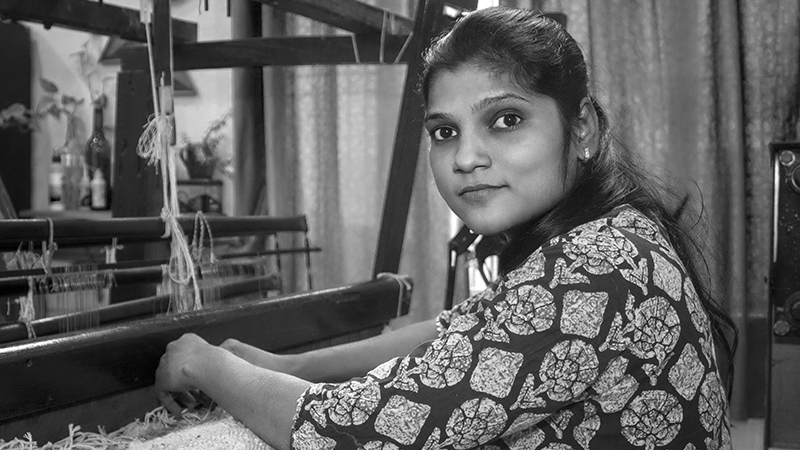





Varanasi has no women weavers. The female workers there are delegated menial tasks, such as stain removal on fabrics, side-cutting of zari, and ironing the textiles. It is a place of predominantly male weavers.
Textile artist (M.F.A in weaving and textile design from Banaras Hindu University) Anshu Singh grew up watching this conundrum. While weaving Banarasi brocade, women were paid less and worked longer. She observed her middle-class mother stitching fall-pico on saris. She would join her after school hours, allowing her an exposure of the burgeoning weaver community in Varanasi.
Soon this hand-work passion took the form of converting katrans into bedsheets, “I watched women make ‘torans’ (gate ornaments) with sari waste, using traditional techniques like applique, elevating it with tassels. I believe fabric has memory, even though you may discard it; it holds a certain history in its heart,” says Singh. If you take Kantha, women made something new with old threads, running stitches giving it a fresh breath of life. The fish and temple motifs they used as decorative art mimicked daily life.
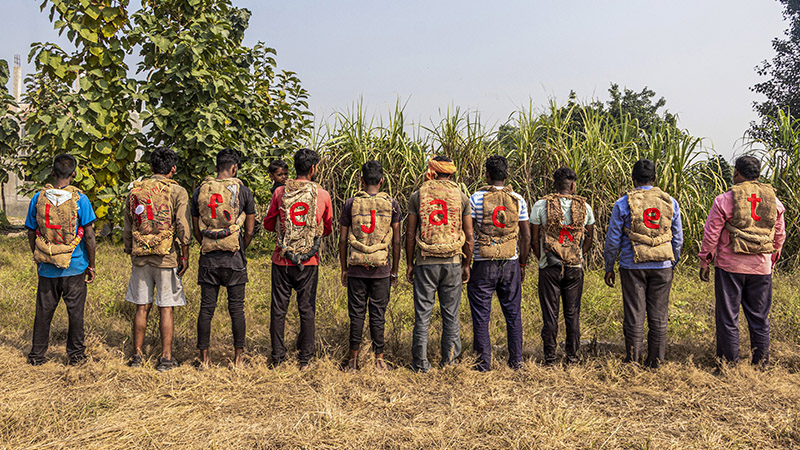
Singh knew she could work with textile waste. From Bhadohi to Mirzapur, she accessed heaps of durries, old clothes, carpet wool, and became an ‘avid collector’. Her mastery in this form was evident at the India Art Fair 2026, in her exhibit titled ‘Repair’ that showcased hand-done tapestry, twist-turned to give a definite form. What she saw she imbibed into her textile art. ‘No more shall I weave a garment of pain’ was an apt title based on a poem by Kabir of the work she did. While jute is a symbol of labour – sturdy, dependable – Singh decided to pay homage to those who carry, more than ‘weight’ on their shoulders every day. “They are in many ways engineers. So I created a jacket they can wear on their backs like a bag, which carries up to 100 kg. I termed it ‘life jacket’,” smiles Singh.
The travesty of modern life is no one wants to follow textile traditions. Power looms do not allow you to correct any weaving mistakes; what you feed you get. But with handlooms, you can alter – therein lies its innate prowess. “Panipat is where the first world sends its textile waste; also Africa. We break it down into yarn. Look at how trade has reversed. We used to send Chintz, exquisite printed cloth, to the world in the 16th century. Fast fashion has destroyed the fabric of life. The biggest contribution of my mom in my life is how she taught me to make beautiful things with meaning out of discarded materials,” Singh adds.
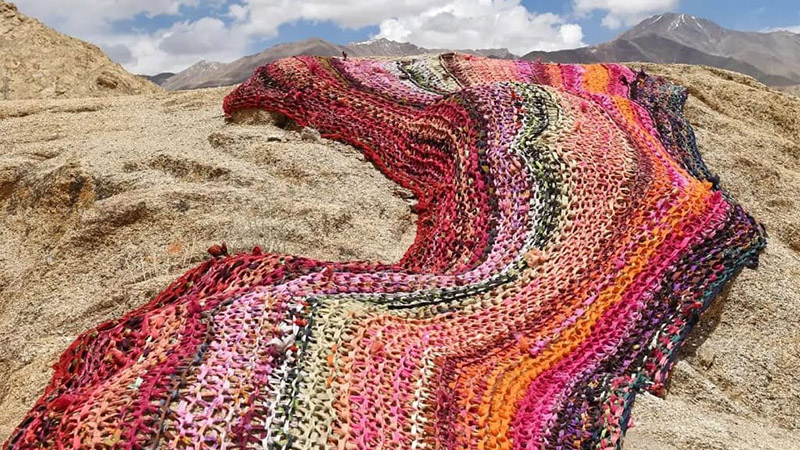
Thus came the ‘River of Sweat’, her most famous 16-ft long exhibit, made of 60 saris, handknitted to show how much we consume, causing environmental degradation. It took four months to make. “Saris were collected over a period of time, mine, mom’s, my sister’s, along with whatever we could find, to reflect the pain and sweat of those who are forced to work in pigeonhole garment factories,” explains Singh.
Singh is part of the exhibition by Latitude 28 gallery titled ‘Lived in Skin’, along with Meenakshi Nihalani and Sabeen Omar.
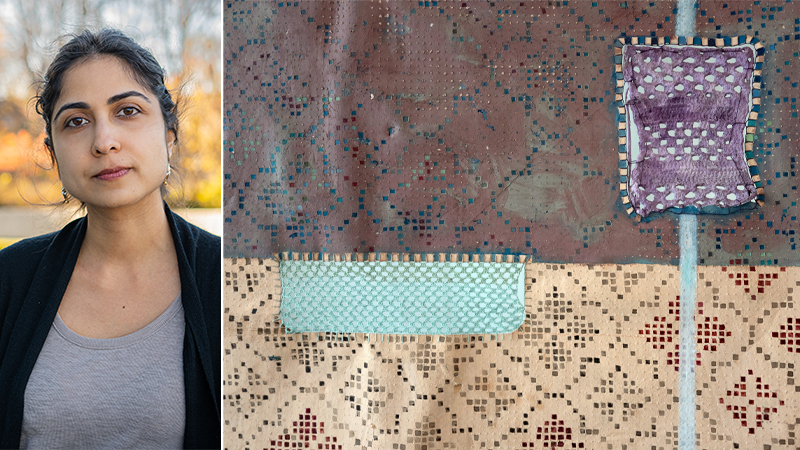
Omar is a Colombo-based artist, born in Madurai to Gujarati parents. Surprisingly she studied Maths, then painting. However, her style had a western aura. She watched her mom take scraps from tailors and craft new garments. Omar uses cardboard boxes, torn bedsheets, dips them in paint, and develops a surface with a character of its own. Even humble handkerchiefs that were pinned on school uniforms served as a leitmotif. From Islamic architecture to Mumbai’s grills, which have an interesting pattern, she imbibes her surroundings, and then uses it in her work. “I often ask myself, do garments have a soul? Clothes have sentimental value. I embellish it with beadwork, crochet, embroidery, and then paint hoping to question – what an artwork can really be,” says Omar.
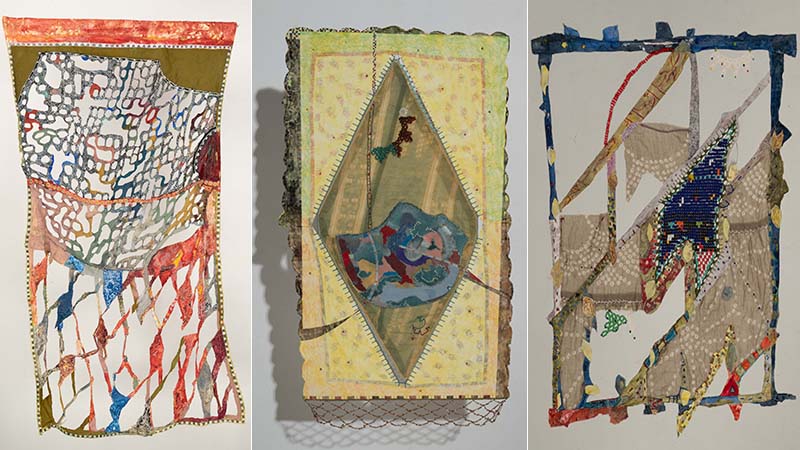
Sometimes in her oeuvre, she frames her mother’s Bandhani kurta, (ikkat dupatta became her top) maybe reminding her of her presence. She tells me: “We all have souls, inner lives, but we can’t see them, they do exist, isn’t it? They are shadow pieces whether it is a tissue box, associated with pain – small object, big feeling – it is a metaphor of suffering – human strife,” says Omar, who was taught crochet by her mother.
Whatever speaks to her, especially reading material, she preserves in a small diary, like the poem ‘Is sorrow the true wild?’ by Ross Gay, and Hugh Prather’s spiritual notes, which served as monikers for her artworks.
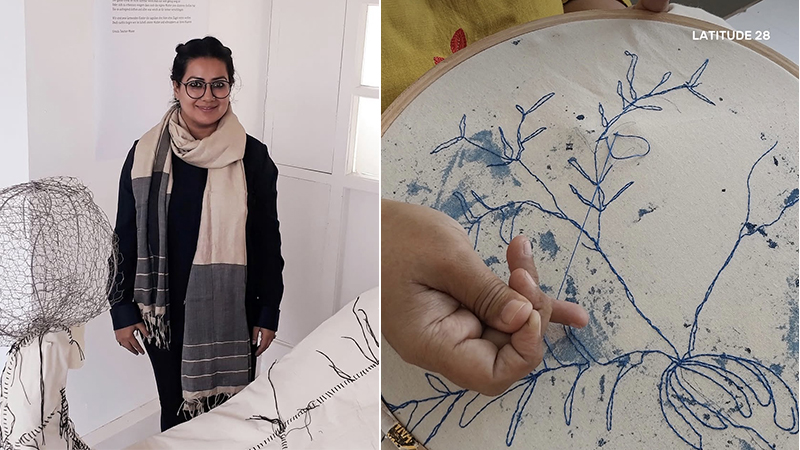
Interestingly, on a weekend, malls are full and galleries empty. But I was fascinated with Meenakshi Nihalani’s textiles, especially her work with indigo. Nihalani studied sculpture at the JJ School of Art. She was deeply moved by the Partition, and began retelling those heart wrenching stories of loss, war, separated families, and abandoned homes, through her artwork. “I used to watch my grandmother make pickles; the whole house participated. The jars narrate lost time, man-made borders, taste and aroma of food, conversations, and laughter. “No two pickles are alike. The whiff of dried mangoes tell stories of migration through the eyes of women, who found a vent in embroideries. My family came on a steamer from Sindh. Lakhs of people took a chance on the choppy waters of the Arabian sea to Porbandar; some went to Punjab from Firozabad, and later settled in Agra,” says Nihalani. She remembers the recipes she had learnt from her grandma during her short trips, those summers spent in Agra, where they settled post-partition. “Pickle making became a story of sharing tales of struggle; it could never erase her pain,” she says.
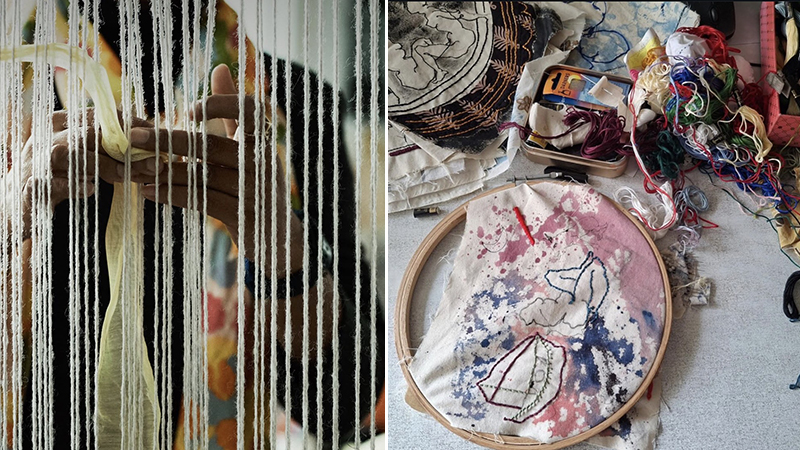
Women, she believes, carry trauma within them, as they are the worst hit by war. “I observed how my grandma carried antique house keys, and hid important things in rice vessels. For me, pickle burnis are a metaphor for migration, reflecting a life of ups and downs, where families became collateral damage in politics. My maternal aunt was just 13 during Partition; her whole world turned upside down as she went through extreme internal turmoil,” she explains, adding, “I was an introvert; stitching helped me process grief.”- Asmita is the Lifestyle Editor of NRI Focus. She is an award winning journalist who has been writing on fashion for the last 32 years
Leave a Reply