
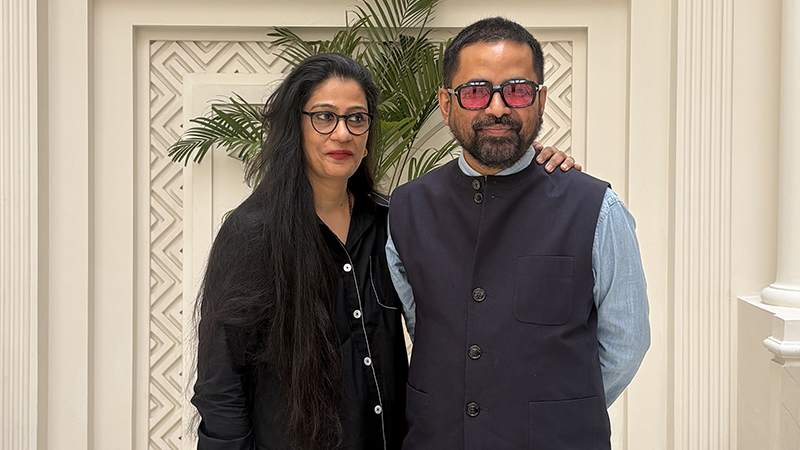





You can hum along if you are from my generation – Yeh Jaam Bhare Bhare immortalized by Kaifi Azmi, sung by Hemant Kumar from the 1960s, or my favourite Bade Achche lagte Hain as you enter the new 26,000 sq.ft. ‘Citadel’ at the heart of Delhi’s Couture Street, One Style Mile.
The staff with folded hands welcome you with a ‘namaste’. A youngling asked, “Sorry who are you?” Frankly I’ve given up.
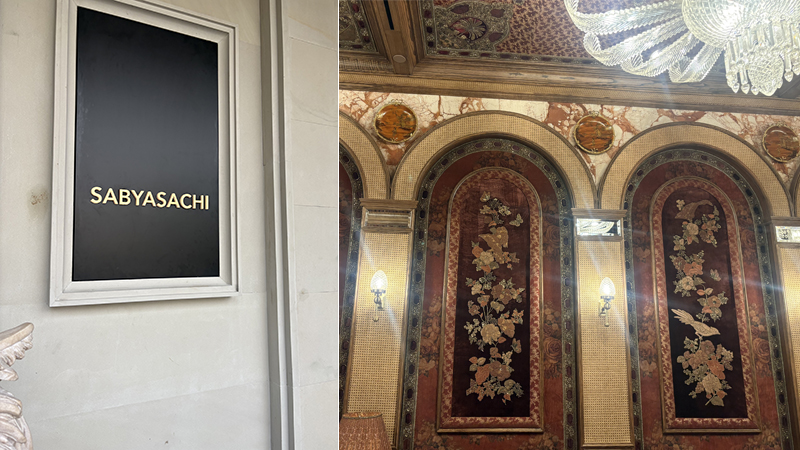
Wait there is more. I didn’t count the paintings and artefacts like other diligent journalists, I decided to decode the man based on what he collects. I love books! Middle-class girls have an ongoing love affair with them.
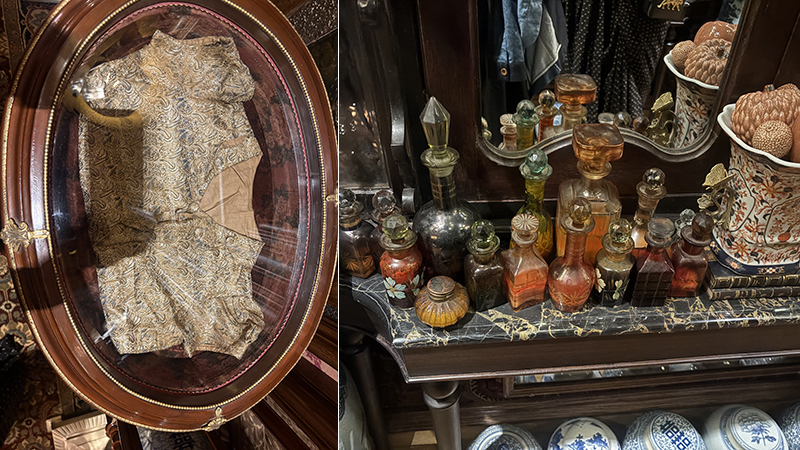
Magnificent carved mirrors, thousands of ceramic apples and grapes… I lifted one to see if it was real; it wasn’t “made by a struggling artist I discovered,” Sabya told me. He added, “The glam of Calcutta, I can’t put a finger on it, it’s almost sexual and slightly dark. It comes from a very private chamber of the mind.”
The self-taught designer collects Chinese pottery, big and imposing, as you walk in the narrow lanes of tunnels he has named ‘Chowringhee’ (also the name of a bestselling Bangla novel by Mani Shankar Mukherjee, 60s) inspired by where his office is, and the famous street in Kolkata – ‘Hogg’.
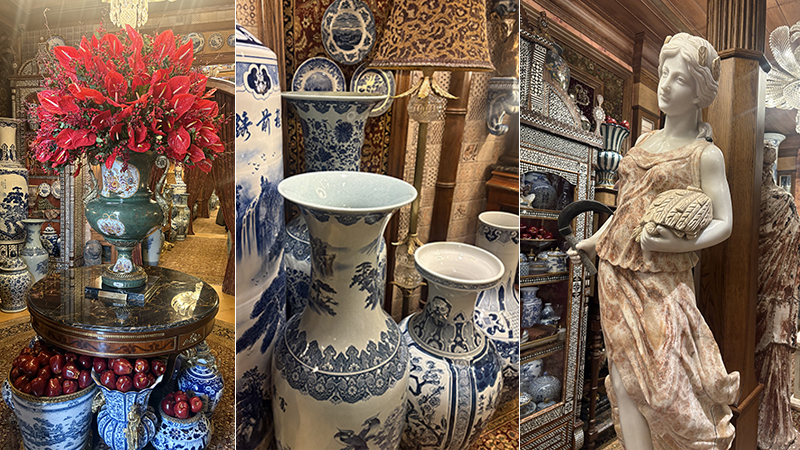
You walk in constant dread… you might knock one of the artefacts over. I don’t know if you know but Sabya wasn’t born rich. He told me he sold jewellery on the pavement, once attempting to end his life as he suffered from debilitating depression!
My guess is Sabya is looking at how the British shaped the city which served as the capital from 1772-1911, versus the rich Bengali landowners who built palatial mansions with Greek Corinthian columns and marble statues – an ode to European architecture.
When we come from nothing – like me and Sabya – we become collectors. The only difference is he has semi-precious stones, emerald, rubies ceilings, tiger print lampshades, old paan daans in brass, vintage Banarasi saris put in glass cases. He peppers these vintage trivia with brass plates of his beliefs.
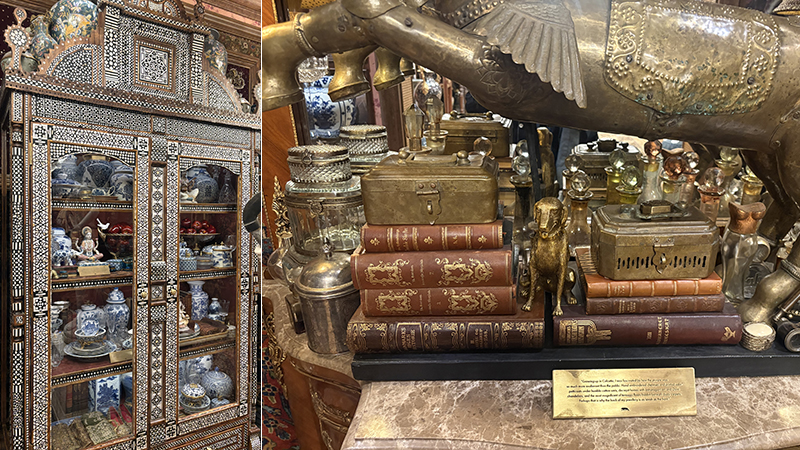
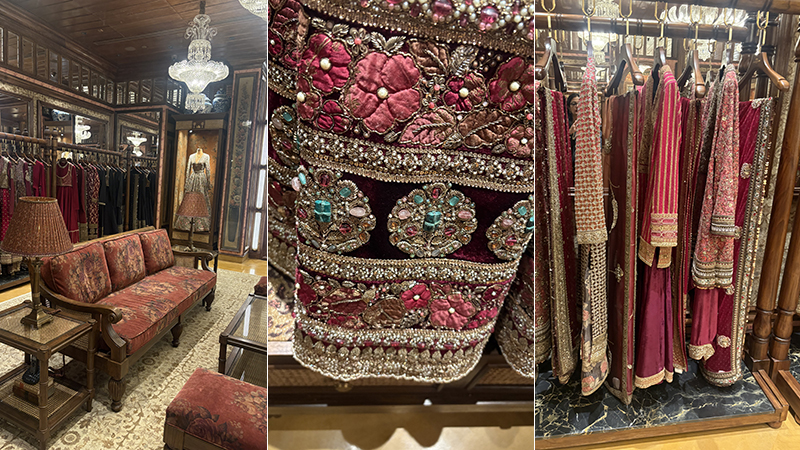
You can buy Rs. 38 lakh lehengas (applique, semi-precious stones, 3D flowers, pearls) while savouring the aroma of a cauldron full of mogra flowers as scent fills the air. Jahnavi dressed in a polka dot charcoal sari with a tiger Sabya sling bag, my guide for the evening, had studied fashion in Paris at ES Mode, and joined him in 2014. “He is an absolute lover of art, craft,” she tells me as I watch the diamonte tiger belts attached to lehengas; brides really like it shiny!
The store was overflowing with art from Sabyasachi Art Foundation. Switches were old school, with flick systems, carpets, chandeliers specially made for the boy (Sabyasachi) who once came to see me in a hand-drawn rickshaw in 1998 at Taj Kolkata.
I don’t know if Sabya has found love. His bags have a golden Taj Mahal. He displays an exclusive line of saris — tissue-zardosi — Rs. 13 lakhs to Kashmiri ek taar, Jamevars, with Banarasi pleats. In 1917 Angelo Firpo, an Italian immigrant opened his restaurant in Calcutta by his last name, where Bengalis would indulge in a little cha cha, wearing pearls and pochettes. The store could be a reminder of old Calcutta – the Tram that once jingled across his home, as Nikhil who studied marketing at IP University, manages his accessories department tells me. “We are Indian and proud of our craftsmanship, which is now going global under our own name,” he says.
Besides resin, leather, glass beads, ostrich skin, they also sell exotic skin-bags that can go up to Rs. 3 lakhs.
Sabaysachi Mukherjee’s new store is hardly 100 metres away from the old one, which was an ode to decadence but wasn’t spilling with a museum-like collection. What makes me wonder is how the boy from the wrong side of the Howrah, understands or rather reinterprets the concept of luxe? Is Sabyasachi a character from Sankar’s ‘Chowringhee’? A front desk boy who watched the rich 1950s Calcutta, after he accidentally lands a job at the Shahjahan, the most luxurious hotel. Maybe!
Most fashion journos have written about 120 chandeliers, 200 antique carpets, 300 original paintings by artists of the Sabyasachi Art Foundation, more than 100 antique textiles, mirrors and historic decorative objects. But what about his MET gala jewellery?
The Byzantine collection is almost 5,000 years old, dating back to the 11th or 12th centuries and recreated by artisans in Sabya’s atelier. “Past is the new present,” he says, but this is separate from his precious jewellery line where a choker can cost almost Rs. 20 lakhs. “I chose each stone, also where to place it,” he tells me as I read on a brass plate, “power lies not in display but in discernment”. Really? Your store is the exact opposite, just like your home, your expensive cashmere shawls, Rolls Royce to animal skin shoes to often flaunt.
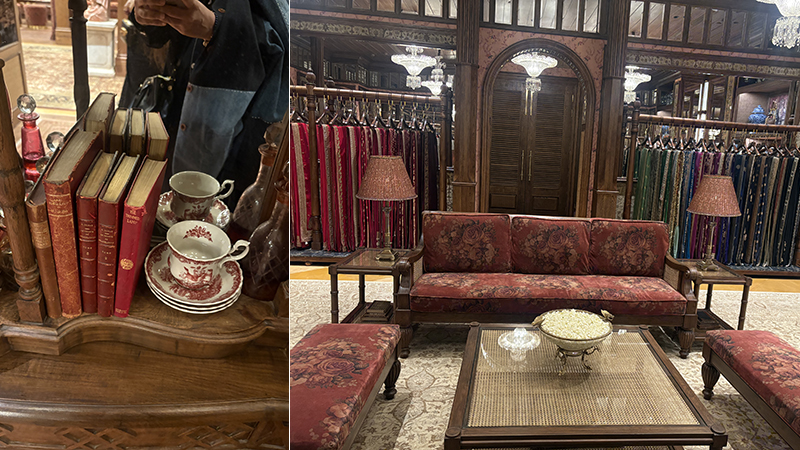
That’s why I found the tea room, based on Satyajit Ray’s ‘Jalsaghar’, or the music room, an ultra-luxe way to wear and buy bridal. The 1958 classic Bengali drama was about Biswambhar Roy, an ageing zamindar with diminishing wealth. It poignantly shows how he hosts lavish classical music concerts to satiate his pride. One look up in this room and you watch in awe Lapis lazuli and turquoise, ruby-studded ceilings below flowing hard brick tiles. “It is to show the friction between a high-low, as well as elephant howdahs, made from solid wood, embossed with gold, silver, encrusted with precious or semi-precious gemstones, pearls came with velvet/silk brocade cushions,” content creator and part of the Longform PR team, Harveer tells me as he reads from ‘Cheat cards’.
Gen Z, I tell you, can only remember so much. Is it due to social media addiction, and the lack of attention?
Sabyasachi’s wholesale director Stephen Bogunia from New York, who grew up in North Carolina, working with a French brand Chanel for 10 years, knows about intricate embroideries through the legendary Francois Lesage. He says, “I didn’t know this kind of exquisite craftsmanship existed before I met Sabya; I thought India was a country of peacocks and snake charmers, the very literal translation of how the West views it.”
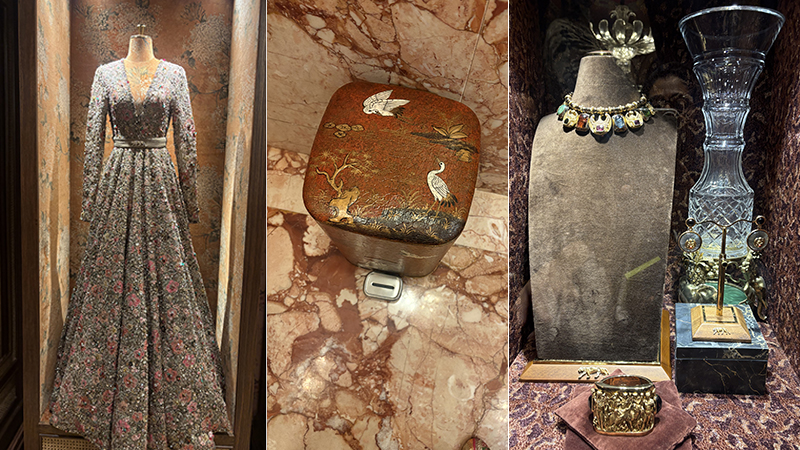
When I asked him about Sabya’s obsession with Chinese pottery, he laughs, saying, “Calcutta was a trading hub, a mix of East and West, due to commerce migration. Sabya sees Calcutta as Constantinople, which for over a thousand years was a centre of wealth and exuded power. I was fascinated by the ginger pots and tea jars available in Calcutta.”
He met Sabya at the Bergdorf Goodman store, the latter showed him his unfinished space in NY. He may have worked with Lesage, who’s had many fashion clients, including Balenciaga, Balmain, Chanel, Dior, Givenchy, Christian Lacroix, Elsa Schiaparelli, Vionnet and Yves Saint-Laurent, “But Sabya’s embroidery has more depth. Calcutta reminds me of Boston, it is the epicentre of intellectuals-you have Harvard and MIT there-it is monastic in a good way,” says Bogunia.
Sabya openly admits he hates Press conferences. He emerges once in a year to tell us he is still around. This time he came with Josh Romm, head Global Licensing & Partnerships at The Metropolitan Museum of Art. “There is a saying of Rumi, what you seek is seeking you. I am not much of a seeker. When MET called me, I thought it was Spam, just like when my store in Mumbai was named one of the top seven World’s Most Beautiful Emporiums by the prestigious Prix Versailles architectural award, September 2024. I live a quiet life, but we live in strange times – history can be 6 years, days or even hours old due to the digital world,” he adds.
It is a dangerous time, where propaganda and fake news exists. How do you find the truth? He admits his research in fashion is intense, on the other hand Gen Z struggles with authenticity, “there is no identity without the past” he explains. The MET opened its archive for him, “I am not creating products, but eco-systems”. Romm confides, lost art forms, historic techniques need to be kept alive, whether it is Islamic art or Byzantine era.
“Many weavers struggle to feed their families when the season is low, so we started ‘Save the sari’, an attempt to remove seasonality of the drape. Commerce helps drive eco systems, circularity important for creative fields,” he asserts, adding, “I aspire people to go back to museums, as that’s where the truth resides.”
Funnily, he admits, “It is a complicated store”, when he designs a space, he takes crafts for granted, personally he doesn’t like owning art, or textiles, he prefers to share with the world. “It is wonderful what human hands can do,” he smiles.
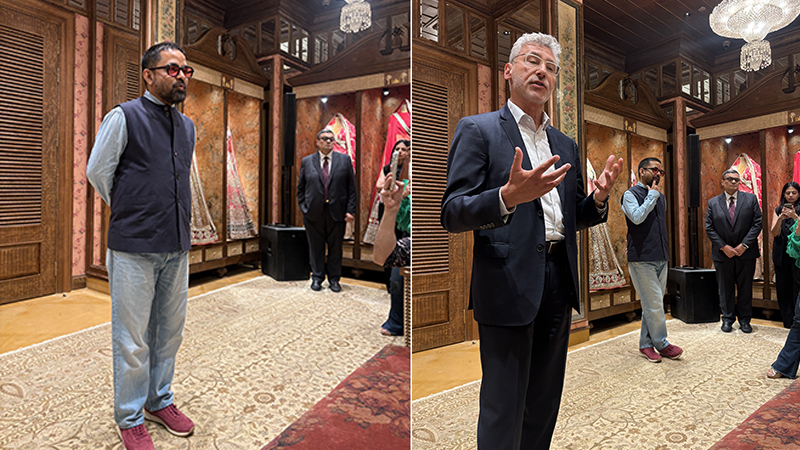
There couldn’t be a more befitting end — in Bengal, we all know social currency was culture not moolah! The key is how the City of Joy served as a historical, trade, logistics, financial hub for Eastern India and South Asia. Interestingly, the Bengali babus tried to retain past glory by getting reclusive artistes to perform in Nachghars or Jalsaghar, which Sabya paid tribute to, their sheer excess.
Here is the conundrum, dressed in faded jeans and waistcoat, you are selling ostrich skin and displaying Salar Jung Museum inspired chipped busts mostly remade. I don’t believe you when you say “Power lies not in display but in discernment” as you seem to enjoy it both in abundance, isn’t it?
As I walked out my heels came off, I hobbled my way to the car, and wondered, the Sabya I knew came late, as his rickshaw broke down 27 years ago. Would I have ever thought one day he would reach these heights? Frankly no, but I am reading Less Than Zero, Bret Easton Ellis, who says, “Wealth consists not in having great possessions, but in having few wants.” – Asmita is the Lifestyle Editor of NRI Focus. She is an award winning journalist who has been writing on fashion for the last 32 years
Leave a Reply