
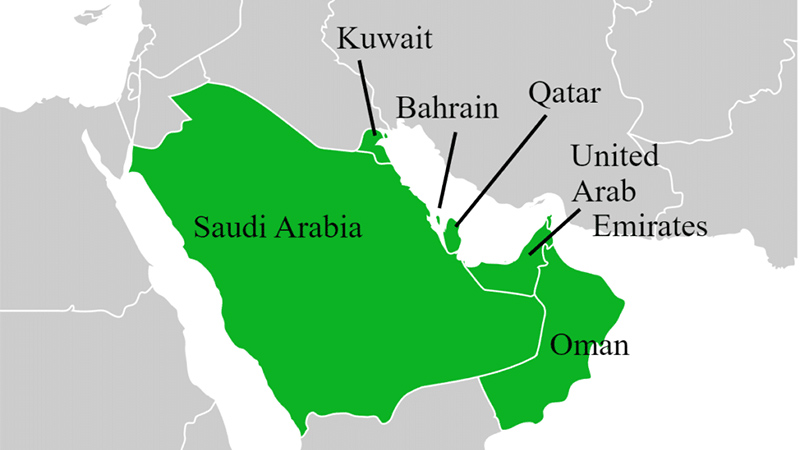





As the Middle East conflict rages on with little or no signs of an early resolution, Iran in a strategic fashion has hit out at the Gulf Cooperation Council (GCC) States. This is for the first time that all the six GCC States have come under fire during a conflict in the region.
The 12-day war in June 2025 had not affected either the GCC States or the global economy in the manner in which the current conflict has. It is also important to remember here that this is a war of choice undertaken by the United States and Israel. It has been repeatedly pointed out by many, including some in the US administration, that there was no immediate threat from Iran and also that the US was not prepared for this. Also, it needs to be highlighted that the GCC States had pressed upon the US not to strike Iran, anticipating what the region and the world is currently witnessing.
For Iran, which is facing an existential crisis, the push back is simple. By attacking the US bases and other facilities in the Gulf States, it has brought to the fore an economic cost, which is shooting global oil prices, a disruption in supply chains and fears of a recession in countries like South Korea and Japan.
The closure of the Strait of Hormuz was always a fear with 20% of the world’s oil and gas passing through it. The heightened insecurity and the refusal of insurance companies to provide cover has resulted in traffic in the Strait halting.
Gulf States such as Qatar, which provide much of the world with Liquified Natural Gas (LNG), have halted the production sending jitters all around. Some estimates point out that these are the worst oil and gas shocks to the global economy in the last 50 years.
The US and Israeli air power have bombed Iran and killed many of the Islamic Republic’s top leadership including the Supreme Leader Ayatollah Ali Khamenei. Iran has responded in an asymmetric warfare using drones to target many of the US military bases in the region as well as facilities like airports and oil bases. This has brought much of the economic activity in the region to a halt. For example, the Dubai International Airport is the busiest international airport in the world. A temporary halt there has set off a global chain of slowdown in aviation and tourism.
So far, the GCC States have shown remarkable restraint and have wisely refused to get drawn into the conflict. They had pressed upon the US to never start this war, and even now as Iran forces a de facto closure of the Strait of Hormuz, and hits targets in Qatar, the UAE, Saudi Arabia and other Gulf States, the mood remains cautionary.
There have, of course, been some statements like from Saudi Arabia that the Gulf States can exercise political and non-political responses. It would then seem that the Gulf States are giving an advance notice to Iran to not test their patience further.
Tehran, a few days back, launched retaliatory missile attacks on Qatar’s Ras Laffan liquefied natural gas terminal following Israeli strikes on its South Pars natural gas processing facility.
The UAE has been hit by more than 2,000 drones and missiles from Iran since the war started but so far the UAE has shown restraint and not hit back.
Oman has also been hit by Iran and it does seem that the Gulf States, at this point, can stay defensive or go on the offensive. But neither option is an easy way out. It will also not be easy for the Gulf States to coordinate among themselves and stay on one course for all. Going on the offensive could also mean Iran then hitting civilian infrastructure in GCC States that could make matters worse.
This has also led to a re-think in the GCC States about their security. On March 13 this year, former Qatari prime (and foreign) minister Hamad bin Jassim Al Thani called for the creation of a NATO-style military and security alliance. This is indicative of how many of the GCC States are re-thinking their regional security dynamics. The war has also been illustrative of the fact that the US security assurances have been rather lacking. This is despite the fact that the Gulf leaders pledged to invest $3 trillion in the US economy after Donald Trump was elected to the Oval office in January 2025. This again was a war of choice that the US and Israel chose to go to, despite the GCC States urging the US not to.
Once the clouds of war settle over this one, it is likely that there will be a change in the Middle East about how it views its security arrangements. The restraint being exhibited by the Gulf States, even as Iranian drones and missiles fly over the region, is to be appreciated. By refusing to get dragged into this war, the sagacity of the Gulf leaders is on display. But there is always a danger of Iran pushing this too far, and the restraint breaking.
The world would be a more dangerous and volatile place if that was to happen. After all, geography is destiny which dictates that Iran and the Gulf States have to co-exist and it’s better to do that in peace and mutual safety. The coming weeks will however tell the next chapter in this saga. – Simran Sodhi is Executive Editor, nrifocus.com
Leave a Reply