





There is a particular kind of administrative announcement that arrives quietly, and detonates slowly — the kind that takes a few hours to fully process before the implications begin to unspool in genuinely unsettling directions.
India’s Ministry of External Affairs (MEA) delivered one such announcement on June 24.
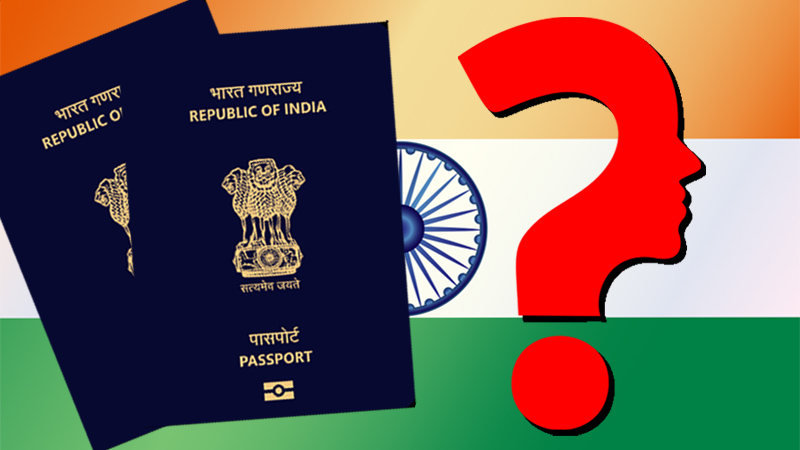
On Passport Seva Divas (Passport Service Day) — a day designed to inspire confidence in one of India’s most essential civic documents — the ministry announced, with remarkable casualness, that the Indian passport is only a travel document. Not proof of citizenship.
The document that millions of Indians have applied for, paid for, stood in queues for, submitted biometrics for, and carried across international borders as the definitive proof of who they are and where they come from is, apparently, merely a permission slip to board an aircraft.
The MEA’s “guiding vision” is ‘Surakshit Passport, Sugam Seva, Sashakt Nagrik’, which translates to ‘Secure Passport, Easy Service, Empowered Citizen’. A secure passport gives way to an empowered citizen it is being boasted, but, then, the passport is not a proof of citizenship. How confusing is that?
The storm that followed was entirely predictable. What was less predictable was the answer to the question that the announcement immediately and urgently raised: if not the passport, then what does prove Indian citizenship?
The answer, it turns out, is profoundly uncomfortable.
Media reports suggest birth certificates do the job. But here is where it gets complicated in a way that affects hundreds of millions of people. The Registration of Births and Deaths (RBD) Act 1969 came into force in 1970 — which means that for a vast swathe of India’s population, including those born before the Act’s gradual integration into civic life to become 100 percent compliant, a legally binding birth certificate simply does not exist. Hospital certificates don’t count as they are not considered legally binding.
Aadhaar cards? Not proof of citizenship. PAN cards? No. Voter IDs? Also no.
Which raises a question that is both logical and quietly alarming: how can it be that the document India issues to its citizens for the express purpose of identifying them to the world — a document that requires you to already be a citizen to obtain — does not, in turn, prove citizenship?
The circularity is dizzying. And the implications are vast.
India is a country of more than 1.4 billion people. Fewer than 10 percent hold passports — which is precisely the argument some will make to dismiss this as a niche concern. But that argument misses the point entirely. The question is not how many Indians have passports. The question is what it means when a government, on a day dedicated to celebrating its passport services, quietly reclassifies its own document.
Governments do not say things without reason. They choose their words. They choose their timing. And choosing Passport Seva Divas — of all days — to announce that the passport is not proof of citizenship is either a spectacular failure of institutional irony, or something more deliberate.
The question on everyone’s lips is an old one, freshly terrifying: is this the beginning of a citizenship-proving exercise in India — even though the government has ‘clarified’ that the announcement relegating the passport is not ‘policy’? Will there be another bureaucratic labyrinth to navigate — another document to obtain, another queue to join, another proof of something that most Indians have spent their entire lives taking for granted? The accident of geography, of being born on one side of a border rather than another, has always felt like an unassailable fact. Suddenly, it feels like a fact that requires documentation.
And documentation that, for millions, may not exist.
There is a more cynical reading, of course — that this is another talking point released into the public conversation like a stone into a still pond, designed to generate ripples of debate while the very real problems of inflation, unemployment, farmer distress and urban infrastructure quietly continue unchallenged.
If so, it is working perfectly.
The debate is raging. The questions are multiplying. And nobody is answering the most important one: If my Indian passport doesn’t prove I’m Indian, what exactly does? – Sushmita Bose is Consulting Editor, NRIFocus.com
Leave a Reply