





Ne(y)t Gain
Imagine a boat race – the traditional Vallam Kali, where chundan vallams or snake boats, controlled by a 100 rowers move on the backwaters during the Onam harvest festival (July–September) in Kerala.
This emotion was replicated on a handwoven carpet that took almost two months to craft by 320 women artisans in Kerala. Sivan Santhosh comes from a family that has been making coir doormats, using rope mat technique that is almost 120 years old. With wooden loom, iron nails and winding, the technique is almost extinct now in Alappuzha. Santhosh belongs to the fourth generation to be doing the craft.
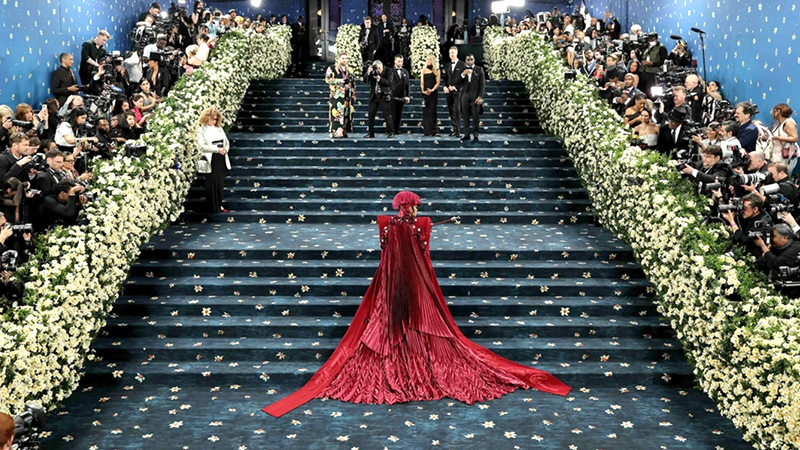
Just like the Kambi carpet, which resembles a rangoli, it was K. Velayudhan, Santhosh’s great grandfather, who set up the Travancore Mats in 1917. Today his great grandson Santhosh, who has reached the Met Gala 2023, has made a cream-coloured runway carpet, hand-painted, as a tribute to Karl Lagerfeld. “We work with IKEA (in Sweden), Ralph Lauren Homes, Crate & Barrel and Pottery Barn. In 2000, my father founded Extraweave, they manufactured the Met Gala carpet – Met ordered 58 rolls totalling to roughly 7,000 square metres,” says Santhosh.
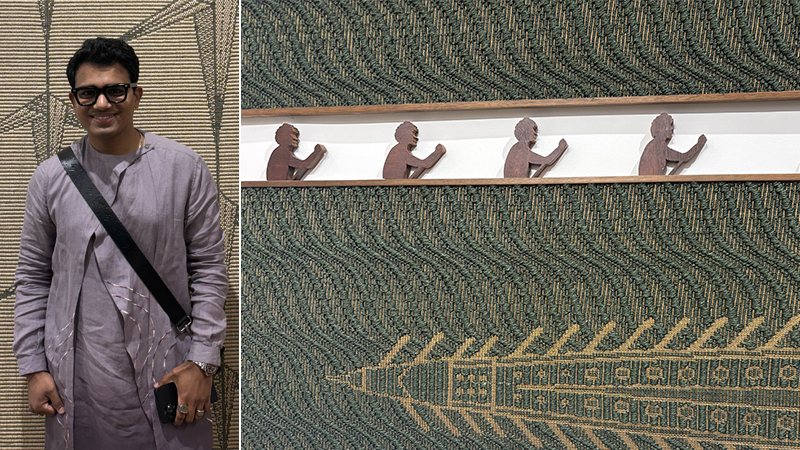
Though Santhosh did start Neytt, his company, which means weave in Malayalam, they have been doing so only for the last four years (30 metres X 4 metres, 30 rolls, takes three months to make). The fabric is made of sisal, which is naturally fire retardant, completely biodegradable-sustainable.
The wall hanging and carpets are made using sisal imported from countries like Tanzania and Madagascar. Sisal is white in colour, very long, strong and durable; it is also used by Aztecs and Mayans to make paper. One can see how culture meets designs – palm leaf hand-twisted into toys, also doubling up for a garland.
Interestingly, the ‘Petty chair’, which also got featured in New York Times is made from recycled plastic bottles. It has no structure, but still sturdy and totally handmade that required folding and stitching by 20 artisans for 20 days.
“I studied computer science engineering in Vellore; then went to Babson College in Boston and came back to join the family business. We got great opportunities. We produced a rug for the White House. I wanted to take the company a step forward,” says Santhosh.
Upskilling women
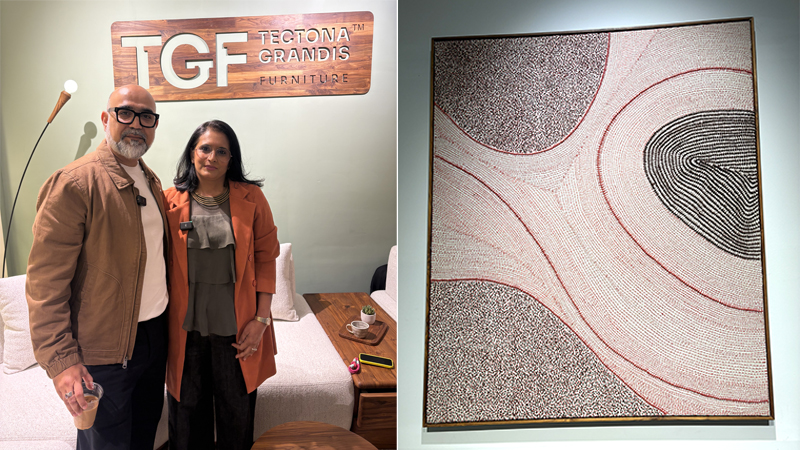
Ahmedabad-based husband-wife duo – Jalpa Amin, textile graduate from NIFT Gandhinagar, and Dhruvkant, NID furniture design graduate – runs Tectona Grandis. They decided they won’t go to Kutch where there were already trained artisans. They wanted to upskill women living near their factory in Vadsar Village, Gujarat. “We taught them embroidery, and didn’t want to give them cleaning jobs. We taught them how to operate industrial machinery to surface ornamentation. So, the wall art you see is done using freehand style,” says Amin. There’s more — factory surplus is converted into cushion covers, and furniture they craft is from recycled teak, reclaimed from Southern Gujarat. “These are villages with zero skillset, but we trained them to be artisans, which we believe is our biggest achievement,” says Amin.
Tanira for A and T
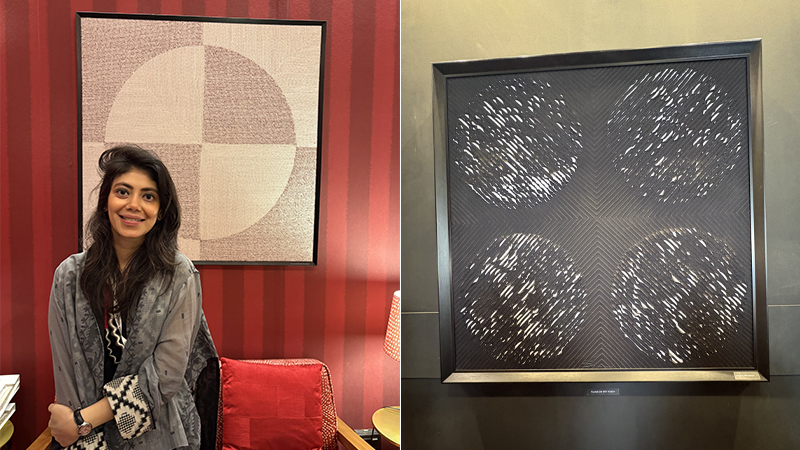
Textile artwork is the new cool and Tanira Sethi, a textile graduate from NIFT, now creative director of A and T Home, knows there is nothing as eternal as French knots and hand kantha, and when you combine them on an artwork, its magic on the walls. Each piece, says Sethi, takes 30-45 days to make, but if it’s brocade and silk then 60 days as it is handwoven in Banaras! The acacia wood armchair was created in kantha, and velvet was easy and you can choose what you like. Upholstery that is available from broken to chain stitch, to kantha to herringbone, it’s spill and dust proof in different colourways. “The silk wall art with discarded X ray sheets is converted into sequins. The double ikkat is added on top of it and can rev up any room,” she grins.
Toda weaves from the Nilgiris
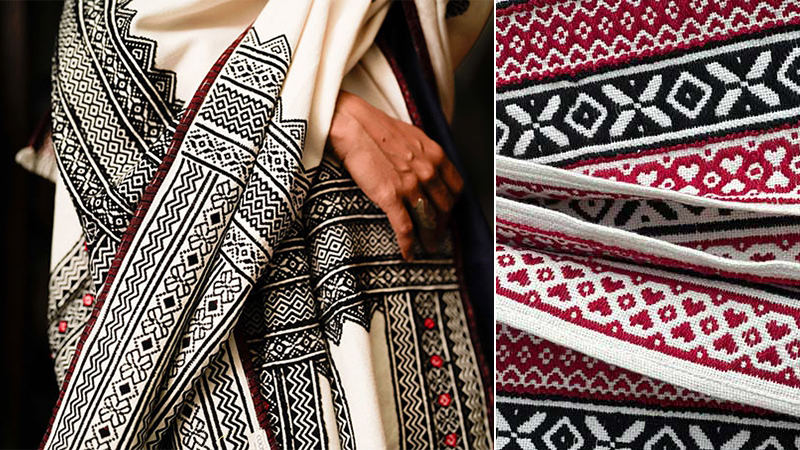
Toda embroidery, or pukhoor, is GI-tagged and hand-stitched by women in the Nilgiris, Tamil Nadu, using red and black woollen threads on white cotton. It uses reverse-stitch technique; only 1,700 artisans are left in the Shola grasslands. “The motifs have honeycombs, braided rattan cane, butterflies, orchids, and sun; it is a handmade luxury that can never be replicated; it is 3,500 years old,” says Sanyam Jain from House of Katachi, which means forms and shapes in Japanese. They have used this ancient weaving technique in furniture, lampshades mixing culture with modernity, creating masculine and feminine forms.
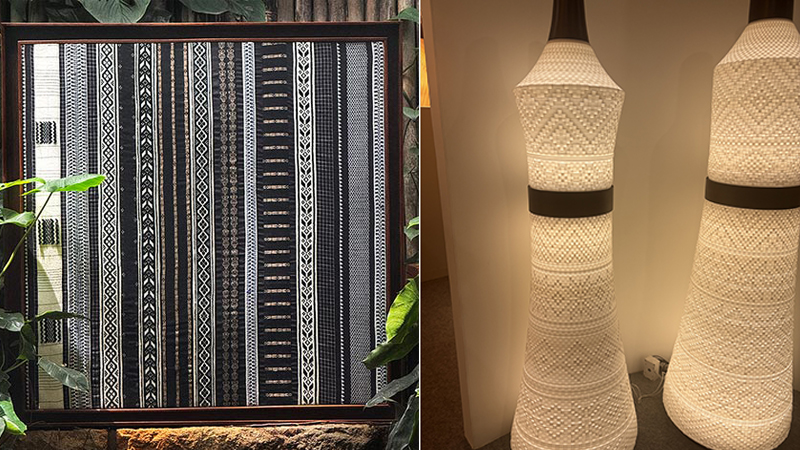
They have really pushed the design spectrum — chandelier in the form of daisies, or grapevines, the typical Indian charpoy into a light, and the Halebidu temple in Karnataka. The 12th century Hoysaleswara temple, UNESCO World Heritage site, served as an inspiration for the lights, the lathe-cut pillars made of soapstone with a polished, mirror-like finish.
Dhaga Designs
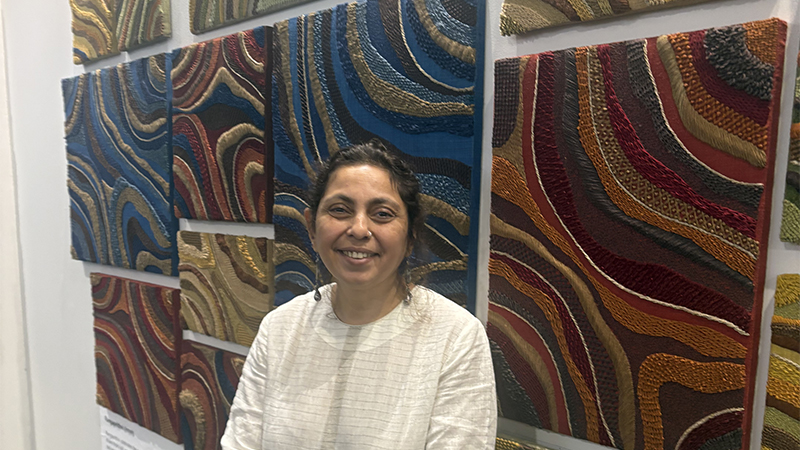
Mehal is from Ahmedabad and largely self-taught. She used to run a boutique called ‘Shaila’ for many years. She has adopted rabari from Kutch, patchwork from Ahmedabad, Mehsana and Bandhani of Gujarat, Sujani from Bihar (Himmat Nagar), Zari from Bengal, and works with over 150 craftswomen. “From colours to dyes, we offer design intervention to make textile wall hangings training artisans tucked away in non-descript villages,” says Mehal.
Madras Makers
Furniture now has a soul – it is not cutting down forests but reclaiming wood from old British buildings. Solid teak, says Prashant Balasubramanium from Chennai. Prem, Prashant and Carola Winnie, started Madras Makers 13 years ago, hoping to craft something new from something old. Bars and beams are handcrafted into chairs and roomy sofas. “We have hired Tamilians and created a community. Our goal is to boost generational carpentry and create local jobs,” says Prem. What elevates the offerings is natural seasoning of reclaimed Burma and Balharshah teak (termite-resistant), Indian Laurel and Flowering Murdah, a luxe rosewood.
Imli Sofa, Lifafa Chair
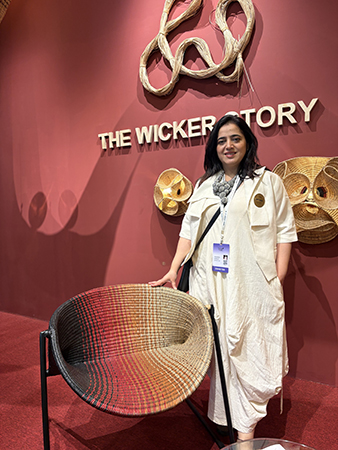
Priyanka Narula decided to pay homage to the humblest of materials, the bamboo. She transformed that into something engaging as well as interesting — thus was born her women-led company, The Wicker Story! It takes 25 days to make one chair by four artisans, using 100% sustainable and a zero-waste production methodology. “Our furniture is biodegradable, made from recycled materials; we use traditional handcrafting techniques only. She began in 2019, but now has 40 artisans. She has the wittiest names – Muggu Bench and Muggu Flower, inspired by the looping geometry of kolam patterns, and Along the River Table, shaped like a flowing mat. My favourite —The Sunset Bench – you can enjoy relaxing on with Booker Prize-winning author Arundhati Roy’s ‘Mother Mary Comes to Me’.
Natalie Borderie: Chanel Buttons
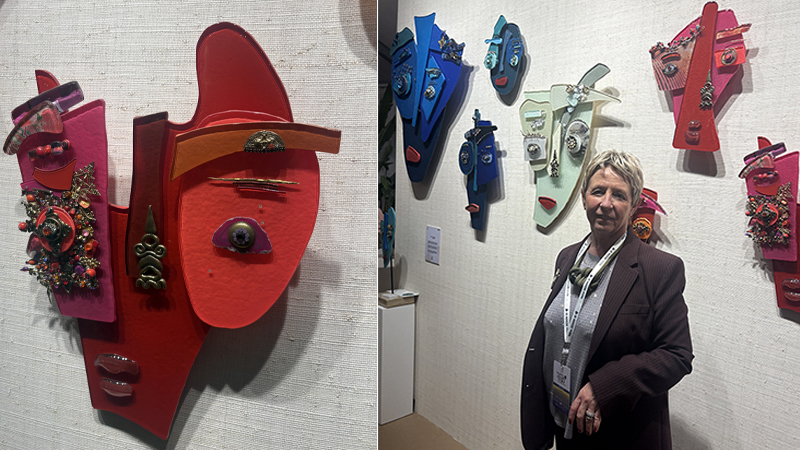
She is a French glass artist and designer whose vibrant colours catch your attention — it comes from her working with haute couture for the last 30 years! Glass is shaped into sculptural glass faces, with eyes, using crystal, metal, and natural stone. She graduated from L’école Sup consolidates the artist’s creativity and creates jewels for Haute couture… glass buttons for Chanel!
From Touraine, in west-central France, termed as ‘The Garden of France’, along the Loire Valley, she began in 1993, presented her first collection at the Bijorhca in 1994, now she retails from 20 countries, including museum shops like Musée Picasso. – Asmita is the Lifestyle Editor of NRI Focus. She is an award winning journalist who has been writing on fashion for the last 32 years
Leave a Reply