
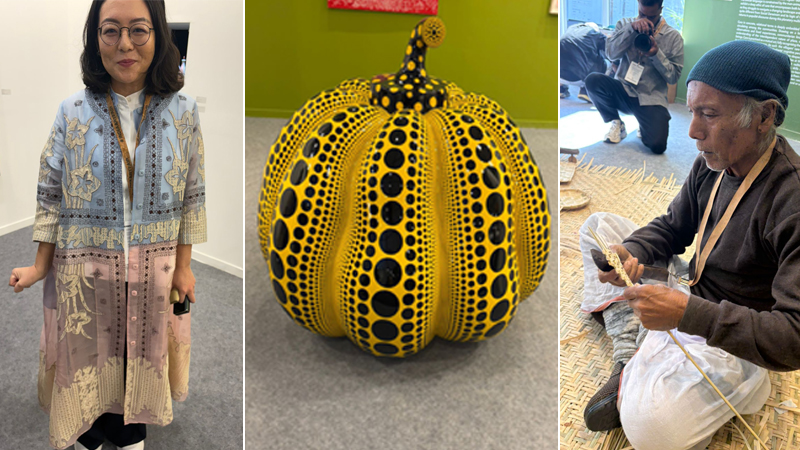





The first impression is not the last, I thought when I entered the India Art Fair 2026, which recently concluded in New Delhi. I saw Jogen Das, now 80, from Dakshinpara Assam, who has been weaving bamboo from the time he was six years old. Bamboo is pliable and strong and comes in many varieties that make it versatile. Das chooses from Bijli to Jati bamboo, depending on their flexibility. His village called Bhalla Karipara (Kamrup) is still hidden from urban chaos. With one instrument – just a knife – he manages to make several things such as a child’s rattle, elephants (inspired by Jorhat Forest range close by), and baskets. “I can make a toy in less than ten minutes, from bamboo shoots,” he tells me, as he continues to hand-weave an elephant mask. He lives in a tree house, for as a farmer he has to guard his crops at night.
India Art Fair is also a great revelation in fashion. Joy Crew, the director of Ota Fine Arts, Shanghai, wore an Indonesian designer Biyan Wanaatmadja’s trench coat patchwork silk, lace, and elaborate sequins, matched it with baby blue talons, Chanel earrings. “My husband travels, he is the one who got it for me. I’m Singaporean but I live in China,” she smiled as she showed me the must celebrated Yayoi Kusama exhibit. “She Alis a legend as she grew up at a time of restriction so her art became a medium of expressing freedom just like fashion.”
Century-old Kalamkari
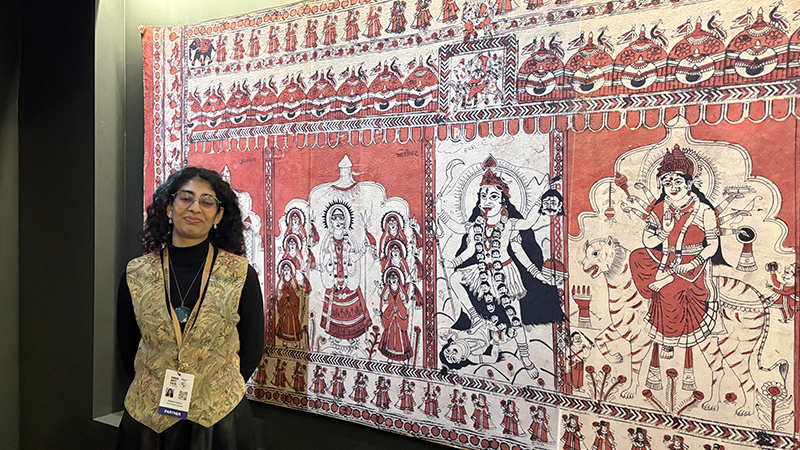
What caught my eye was the Matani Pachedi textile from Gujarat made by the Vagharis community – nomads who resided by Sabarmati river in Gujarat. Vagharis were outcasts but wanted to worship, so the 300-year-old sacred textile art worships the Khodiyar Mata, and is handpainted. Mata is riding her crocodile vahana (vehicle), involves a laborious process, de-starching, treating it with a solution of harda (terminalia chebula), a step-by-step process using madder for reds, jaggery and iron nails. “If you see closely Kaal Bharav is also depicted,” says Preksha, senior archivist Sarita Handa.
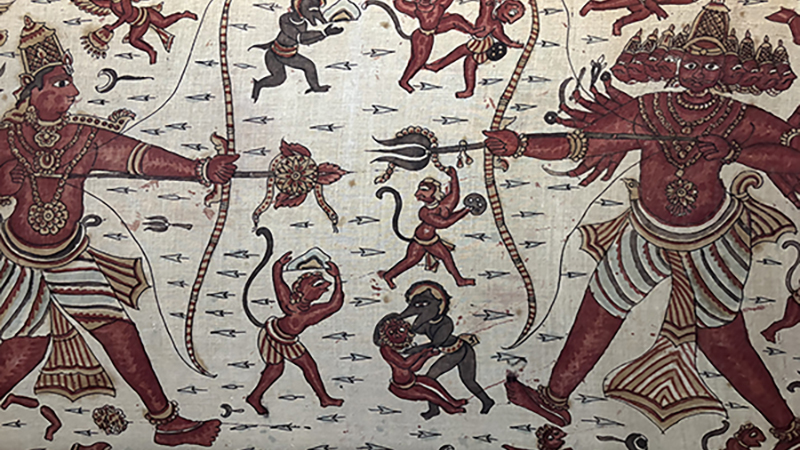
The Ramayan piece had such superlative detailing – arrows of Ravan with Shiva Trident, and Ram chakra with Vishnu, a late 18th century Kalamkari textile. Coromandel kalamkari panel was blockprinted, with Gand Bheruda the main motif, two-headed mythological bird, symbol of power, the bird associated with Vishnu. The Vadiyars of Mysore had this emblem in their palaces.
Satish Gujral
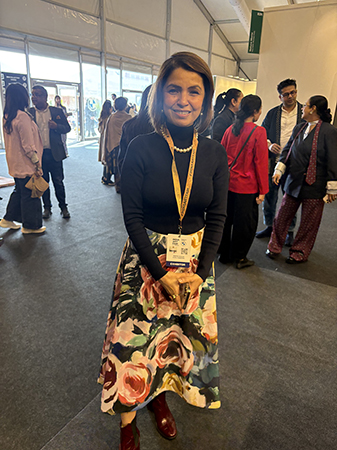
The Nandi series by Satish Gujral who is celebrating his Centenary was shown to me by the very chic Swapnil Khullar dressed in a Ted Baker floral skirt, string of pearls and black high neck. “I think fashion and art are synonymous; both make us happy, doesn’t it?” smiles Khullar.
Sanjana’s Scarlet
The cold didn’t seem to bother Mekhala Bahl, dressed in an olive green dress from Scarlet Sage, a brand by Sanjana Bhuwalka. She was trained at the College of Art, Delhi, and then at Rhode Island School of Design. She is a master printmaker. Her two artworks embodied a spirit of layering — the first one ‘Pressed’ took her over a year-and-a-half to create- think thread embroidered on to silk, then etching and engraving.
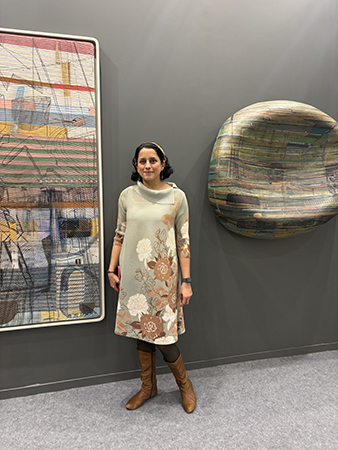
“Finally, we use a press, and ink is transferred on to painting. Embossing excites me; we use etching tools to make marks on metal,” she smiles. The beauty was quilting – what is often used in fashion too, to create an illusion of reverberating sound outwards. “The water colours are then added, almost 16 layers with myriad techniques, in one painting titled ‘Is and always will be’,” she confirms.
Vivacious crimson
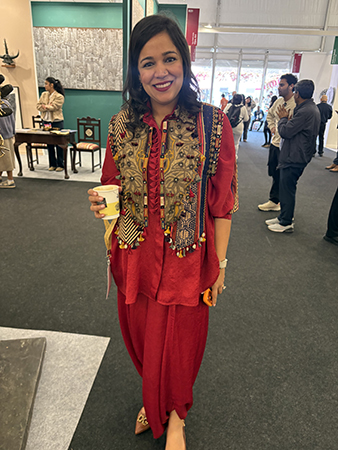
Fashion is omnipresent at IAF, Meher Kalra director Gallery Nvya, was dressed in satin dhoti pants, in vivacious crimson with a tribal yolk kurta, by Rajdeep Ranawat. “I got this from Ogaan; I wanted to feel fresh and vibrant throughout the day, and red makes me happy,” giggles Kalra.
Neither black nor white
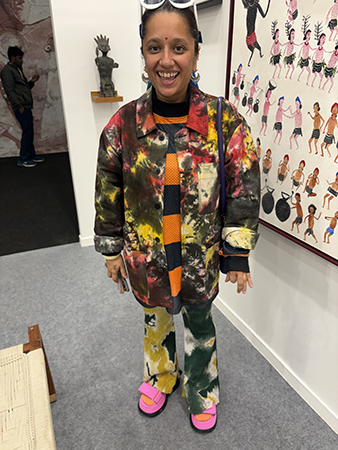
She immediately caught my eye, but I didn’t know she was Toronto-born and Delhi-based Amrit. Dressed in jacket with splatter dye, vintage shibori pants from Kyoto, Japan, she made the heart-shaped bindi herself, and was in white-framed glasses from Canadian flea market, and sandals Barbie pink from Sunnei, Milan, with a kindergarten-for-adults aesthetic.
Intern chic
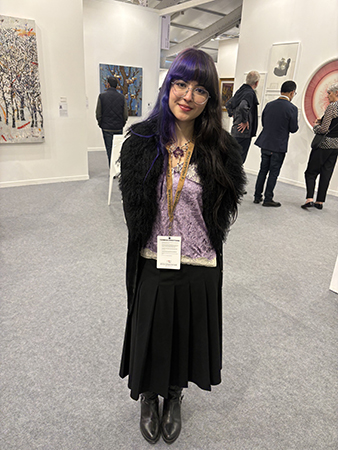
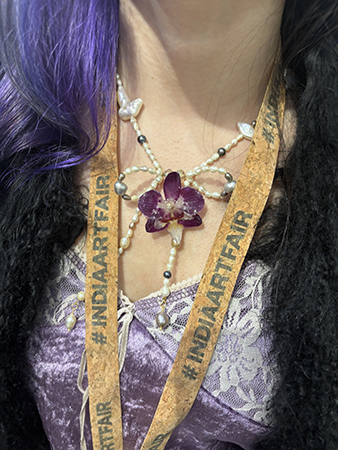
Her purple hair caught my eye, so I went up to Shireen, an intern who wore a Uniqlo skirt and a thrifted top. “The necklace is the showstopper, made with real wild orchids, handmade by Not Just Bijoux, my friend Divya Jalan’s Bengaluru-based brand. It has real pearls and took almost a month to make; what made me buy it is the craftsmanship,” says Shireen. She has recently graduated from Srishti School of Design and counts her mom as her style inspiration. “Purple is my fav colour, I can express myself best through this,” she adds.
Trendy Wendy
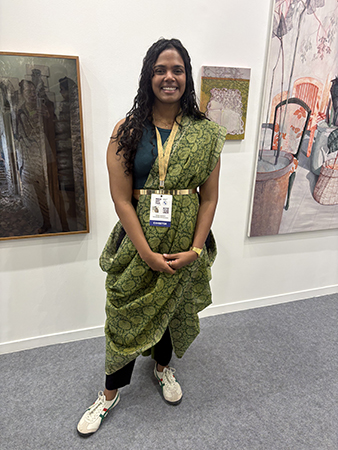
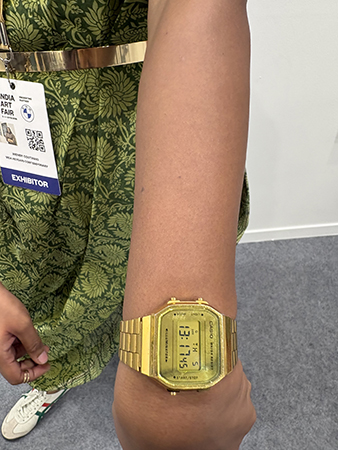
This art curator, Wendy Coutinho from Galley Vida, wore a cotton sari she bought for her graduation ceremony at JJ School of Art, Mumbai, for Rs. 1,800. She teamed it up with a cropped top, kamarband, and Onitsuka Tiger sneakers. “My classic Casio gold watch is the accessory I can’t do without,” she chuckles, adding the sari is the first one she bought from her own money from Borivali, Mumbai.
In the business of fashion
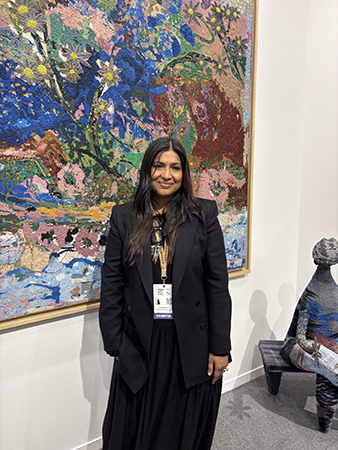
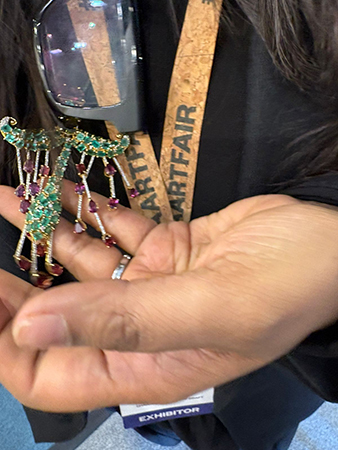
Vinod Maganlal Shah is from Gujrat’s Rajkot. His family ran iron and steel business, but he wanted to do something different and so started Chanakya School of Art in 1984. He travelled all over to revive traditional embroideries. The school has completed 40 years in business, and his daughter Karishma Swali, better known for being finally given credit by Dior’s Maria Grazia Chuiri, completes 30 years in the business of fashion. “Medium is the message-couture and fashion, with 1800 masters working with us – 12th to 13th generation artisans to preserve and perpetuate artisanal legacies,” she says.
Chorus, her latest offering, is a luxury brand launched in late 2025 by her and Avantika Swali, making ready to wear objects of beauty and wellness, channelling the philosophy “honour the hand”, in Kala Ghoda. “I love Kutchi Bharat, but also Suf, Khaarek, Paako, Rabari, Garasia Jat, and Mutava. Look how mirror work along with abla (hand-stitching of small mirrors onto fabric) has been given a finer avatar. India has been a source of wonder for generations for the West from our smooth muslins to natural pigments. We believe in devotion to the practice, which has been around for almost 7000 years since the Harappan civilisation – these art forms are timeless,” she adds.
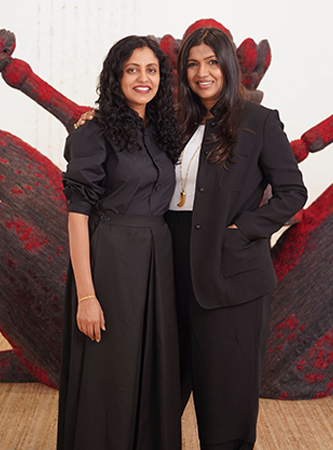
The Chanakya School of Art works with top ateliers in the world from Valentino to Fendi and Gucci. “I must give credit to them on how they expand the horizon, think and stretch the possibilities,” she adds.
Her all-time favourite remains Jamdani from West Bengal, and she says nothing can beat Kantha’s sophistication. “Almost 240 women work in our factory; 1400 women artisans have graduated from our school. Gujarat has the finest of Bandhani and rye dana, which hasn’t been correctly understood and needs to be resuscitated. The biggest travesty that is happening is how some designers are digitally printing these traditional and ancient designs, and sometimes sacred embroidery and dyeing processes,” she concludes as she shows me paintings that have been fully embroidered that you cannot even see the base fabric. – Asmita is the Lifestyle Editor of NRI Focus. She is an award winning journalist who has been writing on fashion for the last 32 years
Leave a Reply