
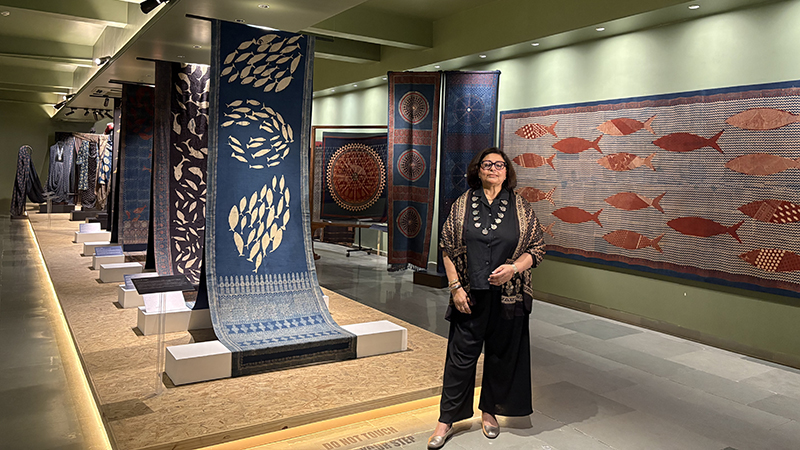





She was dressed in a hijab, Cord Studio linen printed co-ord set (Rs. 22,000), Chanel 19 ruthenium-finish metal bag (Rs. 7 lakhs), Martin Margiela Tabi toe shoes (Rs. 1 lakh), and observing with rapt attention along with three other fashion loving women. They instantly caught my eye.
Meet Shamsa Alnahyan, who volunteered at Art Dubai and London Palestine Film Festival. Women from the Middle-East, I tell you, are so fashionable; the war hasn’t dampened their spirit. But mine got severely affected when I saw the ugly display of money on Dubai Bling (Netflix).
It was a sweltering hot afternoon, as Delhi sizzled at 46 degrees Celsius. It was predicted to be the warmest year, thanks to global warming. As I struggled to stay cool, it wasn’t exactly a good day to step out, I decided to go to my favourite place, the National Crafts Museum & Hastkala Academy, (rather than the air-conditioned mall, right next to my home) to savour ‘Ajrakh: The Blue Gold’, an exhibition curated by Fashion Design Council of India (FDCI).
Alnahyan from Dubai is an art curator who studied creative art, culture, at SOAS, University of London. When I introduced myself, surprisingly, she said, “I come to India very often, to buy textiles -linen, cottons, Kantha, silks and pashmina, the blue in the Ajrakh spoke to me, specially the ‘fish series’ at the exhibition,” smiled the 22-year-old.
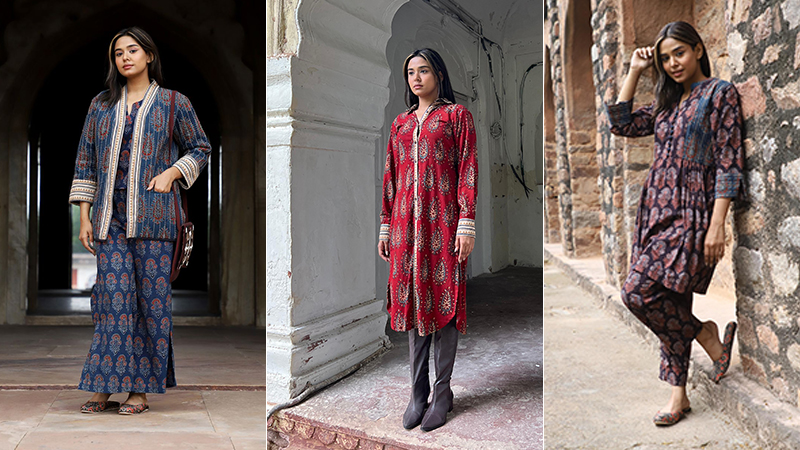
Mariam, dressed in a cherry red engineered shirt, from Turkish designer Baqa, Khayala Asadova (known for nature-inspired motifs, fluid silhouettes), is her aunt, while Mahrah, is from Ras Al Khaimah, northernmost emirate of the UAE. She works in finance, but came armed with a Nikon. “I love taking pictures; crafts serenade me more than numbers. We buy perfumes, as well as zari, from Mumbai. We take it back home to tailor our clothes. We are fascinated by Indian crafts. We don’t have that kind of lineage in the UAE; war has put a lot of pressure on the economy. Coming here is a respite from what’s happening back home,” she admitted.
The Ajrakh exhibit had Shelly Jyoti, Anju Modi, Rajesh Pratap Singh (Ajrakh on Kota), Khalid Amin Khatri, Divya Sheth and Sonia Jetleey showcasing this 4000-year-old craft in a newer avatar – saris, high low jackets, co-ord sets, draped linen, even jewellery, tiered dressed, quilted jackets to wall hangings.
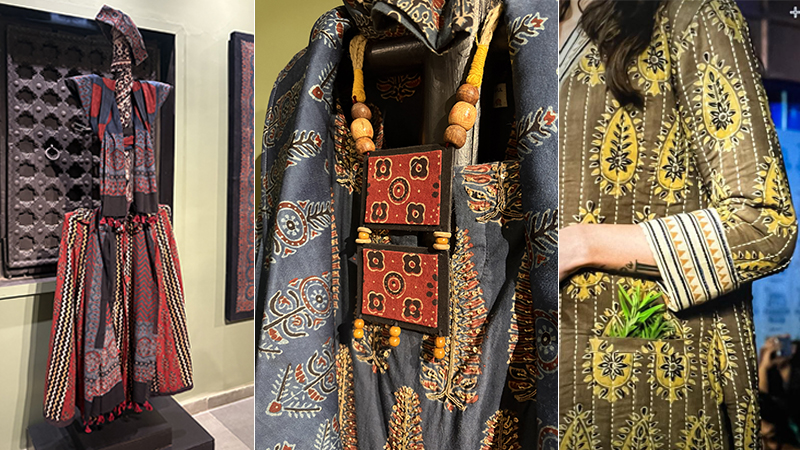
I met three high school pass out students, Drishti, Akshara, Pari, who are preparing for engineering, but wanted to come to the Crafts Museum and see what was happening in that space. “We got to know about this through Instagram. We loved the way Anju Modi draped the fabric giving the skirt a dhoti-esque feel. Our generation has a big problem: we don’t have any patience, these techniques are slow and sure, we are addicted to things that come fast, and have no soul,” said Drishti, who travelled through Metro from Shahdara in that debilitating heat.
Artist Shelly Jyoti, a NIFT graduate, is known for collaborating with 9th and 10th generation Ajrakh artisans who migrated from Sindh, Balochistan in the 16th century. They continue their textile traditions of printing and dyeing in Bhuj, Gujarat. Jyoti worked with Ritu Kumar, in pure zardozi work. When her husband moved to Baroda, she was exposed to indigo, the way the Japanese soulfully executed it. “The role of indigo in the freedom struggle is critical in understanding the political history of textiles. Indigo farmers were ostracised by Britishers as mentioned in texts like Neeldarpan, Dinabandhu Mitra (1860), encapsulating the 1859 Indigo revolt. Its cultivation is thought to have existed in the Indus Valley Civilization more than 5,000 years ago,” she says.
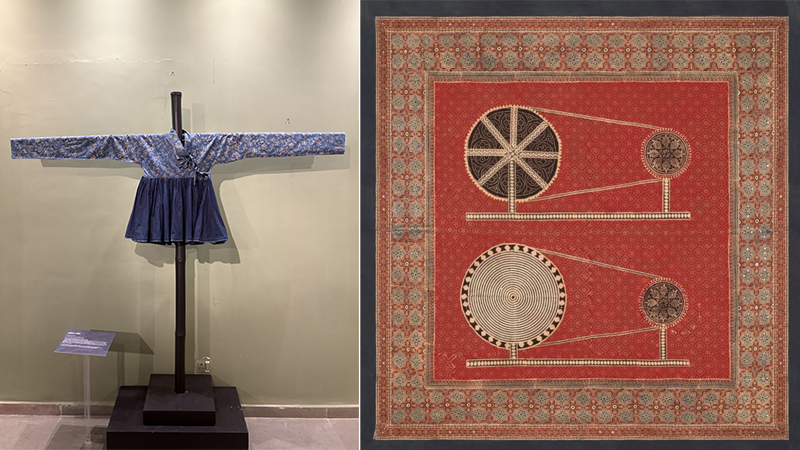
Ajrakh or blue in Persian is an intense form of reverse resist dyeing – a complicated technique at every step, using blocks as old as 400 years. How they make it malleable is astonishing. “It has to be dyed and washed multiple times, then printed. We wait for the colour to bond with the fabric. Three pieces made in this technique from the ‘Charkha’ series have been displayed at Parliament,” she adds.
Sonia Jetleey has been working with Ajrakh since 2014, since her daughter studied in NIFT Gandhinagar. Her line on Mashru took shape during COVID when she launched ‘Sukoon’. “I love what the Khatri brothers do with motifs (ambis, badam, paisley); their blues are hypnotising. Ajrakh is extremely time consuming – takes a month to make. We do quilting, hand done needlework to elevate it,” she explains, adding “foreigners are ready to pay any price for it”.
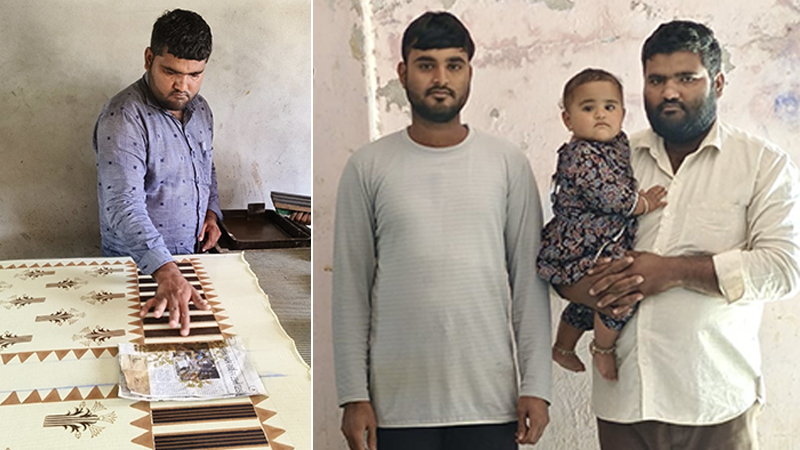
Khalid Khatri has been working with Ajrakh for the last 20 years. His family has been engaged with this craft for 400 years, in a small village of Gujarat, Ajrakhpur. “We use only fruits, vegetables, and plants for the 29-step process to make Ajrakh. We have a repository of 15-16 designs as old as the Indus Valley Civilization. For us, the blue represents the vast beauty of the sky,” he says. Khatri’s part of the 100 families, who are still continuing this legacy. The red comes from dates (khareek), iron, jaggery, imli powder, pomegranate and turmeric sprays, several laborious processes of washing, printing, soaking dyeing, which make the fabric change its entire character, giving it a brand new personality. “It takes almost a month to make the fabric ready; sometimes we need to sell it for a lesser price to feed our families,” he concludes.
Anju Modi known to be a craft revivalist went to Ajrakhpur. She came back fascinated by the fine metal blocks they use, which still look beautiful. “I worked in this craft and didn’t want to change the authentic look, and blocks; so just altered the fabric. Traditionally they use cotton, so I decided to introduce linen cotton. After treatment with cow dung soaking, it turned out to be super supple. We made linen jackets, tunics, short Kedia tops, trousers; kept yardage so that anything can be designed. Ajrakh is truly blue gold,” says Modi. – Asmita is the Lifestyle Editor of NRI Focus. She is an award winning journalist who has been writing on fashion for the last 32 years
Leave a Reply