
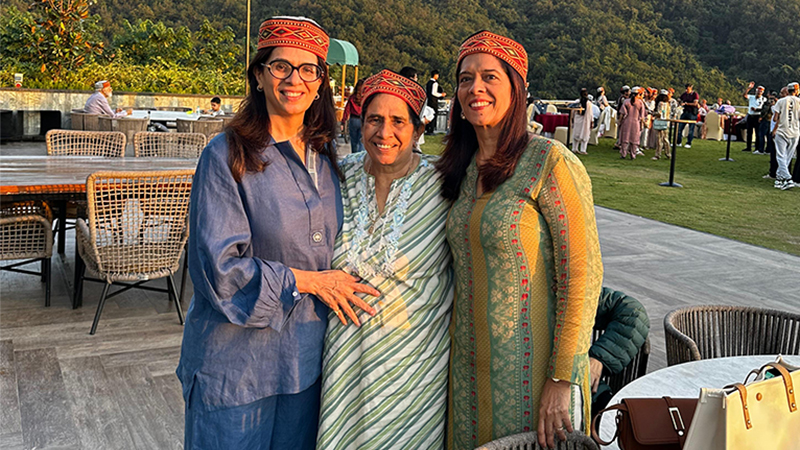





“My mom is a very, very brave lady, raising a family of six children, with limited means. I grew up with tons of cousins, coming and staying with us. Ours was the only family that had moved from Jaipur to Mumbai — so it was a house full of people. In fact, today when my friends come, they remember we had at least five cousins always staying over. It was a big house with lots of love and warmth. In Sindhi families, fashion is omnipresent — mom, mami, masis, were all very fashionable women. I loved the way they dressed,” begins Anita Dongre.

From a 300 sq.ft. space in mom’s balcony in 1995 to a Rs. 1000 crore revenue business, Dongre would tell her college friends that one day she would run a fashion empire. “I dream big; success is relative. I don’t look at my growth or compare it with anyone else. The last two years, I’ve consolidated, stopped expansion, and now want to do slow fashion, which is more impactful,” she adds.
Her mom Pushpa stitched clothes for the first three daughters and then the three boys. Dongre wondered how did she found the time when she had so much to do in the house. “She used to get fabric, and after lunch, instead of having an afternoon nap, she would make frocks for us,” she smiles.
Maybe she got the designer genes from her. “If my mom was not a housewife with six kids, she could have had the opportunity to be a fashion designer. But at that time, women did not even think of having careers. Even in the 60s, no one thought of earning, so I am happy I got to break out and do what I wanted,” adds Dongre.

Her father fled Sindh, like all refugees, when he was 11 years old. They had just the gold jewellery worn by her mom. They sold it and started a new life. He had a tough upbringing, so Dongre grew up listening to tales of his frugal life; she grew up to be always very mindful of how she conducted her life.
“Two things changed my destiny — one was that my dad decided to move to Mumbai before I was born, in that sense I was blessed. It was a more urban Bandra upbringing compared to my cousins, who were raised in a joint family in Jaipur, in Bani Park, a traditional suburb of Jaipur. My grandparents’ home is still there. I really think my chacha’s daughters were raised with too many restrictions; they weren’t allowed to raise their voice. I went to a Convent school, so I had a more cosmopolitan upbringing,” she admits.
Her maternal grandom’s home was on MI Road Jaipur, where Dongre would spend two to three months, living in a joint family and sleeping on the terrace with her cousins. “It was a very interesting upbringing. If you are a girl who has been brought up in a city in India, you have not truly experienced the country. India is in the smaller towns. We used to change trains in Madhavpur, and got to see another part of India, a more colourful and beautiful one. We went shopping to Hawa Mahal and got bangles. My friends used to wait till I opened my suitcase; everyone used to be fascinated by what I bought,” explains Dongre.

Sustainability is the core of Dongre’s life. Even her factory is fitted with a water recycling plant — part of it goes to the sewage system, part for use in toilets. “I care if my husband is brushing his teeth, and the tap is not shut. We get into a fight. I can’t bear to see water being wasted. There was a marriage in the family, and we opened a packet of Lindt chocolate, paper wrapper, and foil wrapper. While putting foil wrapper in the bin, I felt so much guilt as it is not biodegradable. It pains me that we are wasting non-renewable resources,” she says.
You will never see her at any fashion party or awards ceremony. Quietness is the source of her strength. She enjoys being alone, waking up at 5 a.m., meditating, and by 8.30 p.m. she is in bed. It takes a lot for her to get out of her comfort zone. “I am a sun worshipper,” she giggles.
Being a commerce and economics graduate, she studied fashion at SNDT Women’s University. Dongre admits she is not good at accounts. For the last 20 years, she let the creative side of the brain develop, not accounting, but it is important to be able to read numbers.
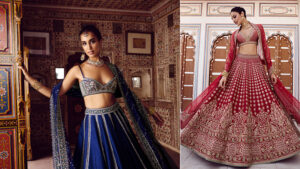
Growing up with six siblings, there was a sense of loyalty and friendship. Their friends were her friends, and so they were one big community. “At 62 years, my biggest achievement is that I took along a lot of people together in my growth, through my creativity given employment. My husband Praveen has probably visited the factory once in his lifetime, but he has respected the fact I need to go to work. My work is very important,” she says.
The bond she shares with her son Yash, who studied at Hult Business School, Boston, is unique. She trained him to have a strong value system. As she was the primary caregiver, with Praveen a trader always on the road, it was Yash’s decision to join work. “Yash grew up in the factory; all the masters and artisans knew him. So it was only natural he would join. I took him with me to work during holidays, shaping him before he joined,” she confesses.
She gave him a professional internship at a lower level, started at the bottom to ground him, to now handle business development and stores; it is a clear role. The non-motherly advice given – “Work is religion. Work holds a sacred place in my life. I taught him to do the same. There are differences between mom and son. I sit him down and explain. We learn from errors,” she laughs.

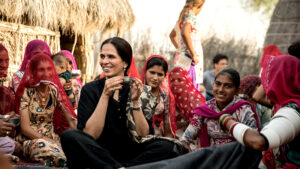
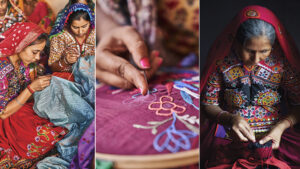
Dongre has worked with many artisans — mainly women of SEWA — who continued to enjoy working with them, and wanted to take work back to villages to have a sustainable economy. “I feel double gratification when I take work to villages. When women are empowered in villages they use the money well,” she adds.
Money hasn’t changed her. “I’m the simplest person you will ever meet. I have a spartan wardrobe, drive an electric car, do raffu of my clothes, wear them till they fall apart, repeat my clothes, wear things till they are torn and tattered. I keep changing sizes due to weight fluctuations, so my old clothes are passed on to nieces,” she says.She did her fashion thesis on Ralph Lauren and Armani. Armani is a role model. He worked till he was 91. Rid Burman, the fashion photographer, compares Anita to Armani, as both have similar attention to detail. “But I’d like to be only Anita Dongre,” she chuckles.
With a new store in Beverly hills, LA, one in New York, two in Dubai, the NRI customer bought the Anita Dongre label, when they came to India. NY was a beautiful, emotional experience, the way she says she was welcomed. The first week, young Indian girls came and we were so proud that an Indian label was in Soho. “Sindhis are born entrepreneurs. We do not have a land, we struggle. My dad always wanted to succeed, it’s something he could not do. Maybe I’m just living his dream. My dad went too soon; he didn’t see my real success. He wanted me to have a business in Dubai. When we opened our first store, I put a photo of my dad in the cash drawer,” she adds.
Her mantra for success is simple – go to work every day, do your best, come back, repeat. Luck, and corporate investment-destiny play an important role, as you need to be blessed by the universe, but that is not in your control. Do what is in your control, forget the rest. “Thirty years ago, when I started from my mom’s balcony, customers came, also when we were operating out of a car garage, then tablela in Santa Cruz. I met a lady who told me how we made her first designer outfit from our balcony with two sewing machines. I’m not in the business of fashion, but making women feel beautiful, great about themselves,” she says.
Talking about social media, Dongre believes it is an important tool; you cannot ignore it, you need to learn how to use it, not overuse it, or set limits. “I have set an alarm if I exceed my time on Instagram, but do not let social media use you. You can reach so many people, it helps you build a community, even though it is an overcrowded and saturated place,” she admits.
Is India a country of just wedding clothes? “Weddings are an integral part of our lives as it is all about celebrating, 60% of my business comes from there. But you can have great fashion at weddings — I love designing for weddings, we are Indian and emotional.”
Her daughter-in-law Benaisha Kharas trains her front-end teams – handpicks them. Dongre always tells them a guest is next to god, respect and make them feel comfortable, when they walk into the store. In fact, she sends friends as mystery shoppers to her store to see how sales girls treat buyers. Anita Dongre the person is lazy, often you will find her in an old kaftan at home, wanting her mom around her, as well as family; and most importantly home food.
“My passion is dance, I want to spend more time dancing. I am learning jive, my husband and some Bollywood girls also join in. Though as a child I tried learning Bharatnatyam when my mom slapped me, and said, ‘Sindhi girls don’t dance’,” she giggles.
What’s most important for Dongre is love, and good health, which you can’t buy with money — “I talk to Pushpa my mom every single day; she is 86,” she concludes. – Asmita is the Lifestyle Editor of NRI Focus. She is an award winning journalist who has been writing on fashion for the last 32 years
Leave a Reply